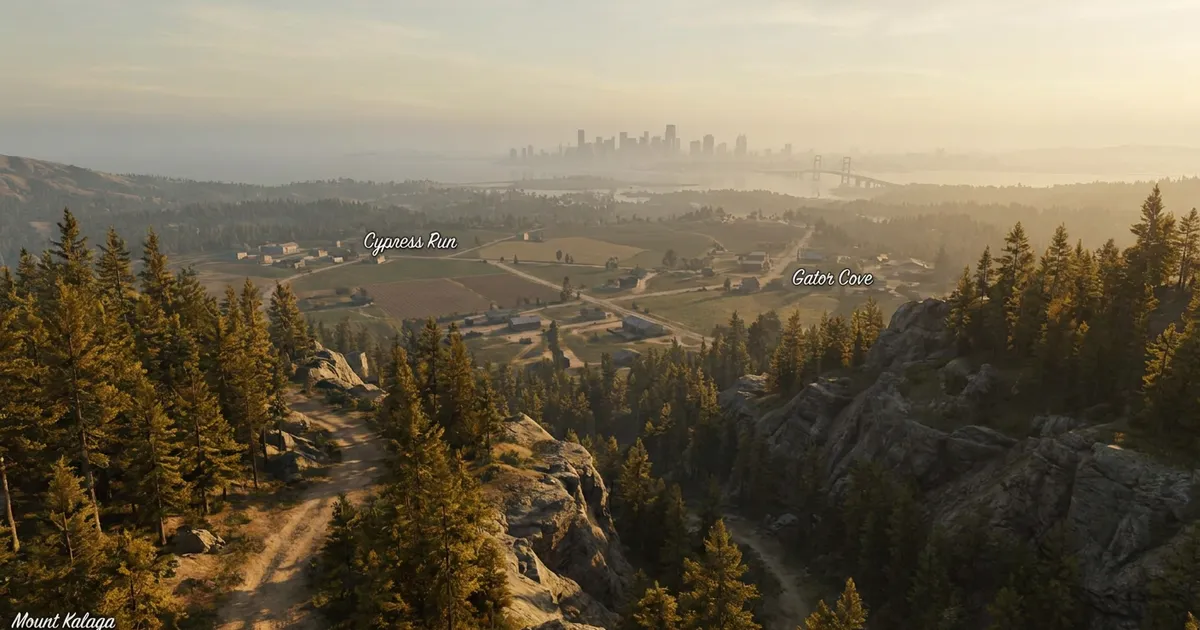
Every mainline Grand Theft Auto map has been bigger than the one before it, except for one, and that exception is the detail every “GTA 6 map size” argument on social media leaves out. Rockstar has not published an official square-mileage figure for Leonida, GTA 6’s fictional Florida, but community mapping projects that correctly called large parts of GTA 5 and Red Dead Redemption 2 before release now put it somewhere around 125 to 207 square kilometers of land, which would make it the biggest map the studio has ever shipped. Here’s how it stacks up against every game that came before it, from GTA III’s original Liberty City to GTA 5’s Los Santos, with sourced numbers and the real story of why the series didn’t grow in a straight line.
Here’s what this covers:
- The ranking, biggest to smallest
- GTA III: Liberty City, 2001
- Vice City: 2002
- GTA 4: the new Liberty City, 2008
- San Andreas: 2004
- GTA 5: Los Santos and Blaine County, 2013
- GTA 6: Leonida, the estimate
- Why the series didn’t grow in a straight line
- Size isn’t the whole story
- FAQ
GTA map sizes ranked, biggest to smallest
Based on land area, from an unreleased estimate down to the smallest released map: GTA 6’s Leonida (estimated 125-207 km²), GTA 5’s Los Santos and Blaine County (~80 km² land, ~127 km² with ocean), San Andreas (~33-38 km² across three cities and countryside), GTA 4’s Liberty City (~16 km²), Vice City (~9 km²), and GTA III’s original Liberty City (~8 km²). Every figure before GTA 6 comes from community measurement of the released games, since Rockstar has never published official numbers for any GTA map, and the GTA 6 figure is a pre-release estimate that will move once the game is actually out.
| Rank | Game | Setting | Land area (commonly cited) | Status |
|---|---|---|---|---|
| 1 | GTA 6 (2026) | Leonida | ~125-207 km² | Estimate only |
| 2 | GTA 5 (2013) | Los Santos + Blaine County | ~80 km² (~127 km² with ocean) | Measured, released |
| 3 | San Andreas (2004) | Los Santos, San Fierro, Las Venturas + countryside | ~33-38 km² | Measured, released |
| 4 | GTA 4 (2008) | Liberty City | ~16 km² | Measured, released |
| 5 | Vice City (2002) | Vice City | ~9 km² | Measured, released |
| 6 | GTA III (2001) | Liberty City | ~8 km² | Measured, released |
A note on sourcing before the breakdown: none of these numbers, including the older games, come from an official Rockstar press release. They’re long-standing community consensus figures, calculated by fans measuring in-game distances and cross-referencing them against known object sizes, refined over the two decades these games have been picked apart. They’re consistent enough across independent sources to trust as a general ranking, even where the exact decimal shifts from one calculation to the next.
1. GTA III: Liberty City, 2001
GTA III started the modern series and, by necessity, started small. Its Liberty City, no relation to the redesigned city GTA 4 would use seven years later, packed three islands into roughly 8 square kilometers, unlocked one at a time as the story progressed. That structure, gating new map sections behind story missions, was as much a technical workaround as a design choice. The PlayStation 2 could not stream an open world the way modern consoles can, so Rockstar split the map and used bridges as gates.
It’s easy to undersell how radical this was in 2001. A fully 3D city you could drive across without a loading screen, populated with pedestrians who reacted to what you did, simply didn’t exist in console gaming before this. The map being small by today’s standards doesn’t change that it redefined what an open-world game could be.
2. Vice City: 2002
Vice City, GTA 6’s namesake and the clear spiritual template for Rockstar’s return to Florida, came out barely a year after GTA III and grew the format to roughly 9 square kilometers. That’s a modest jump on paper, but Vice City did more with it: two large islands connected by bridges, a genuine day-night art direction shift into 1980s neon Miami, and enough vertical variety, from the mall to the mansion to the airport, that the map felt considerably bigger than its predecessor despite the small size difference.
If you want the deep dive on how GTA 6’s version of this city compares region by region, our full GTA 6 map guide breaks down all six confirmed Leonida regions and how they map onto real Florida geography.
3. GTA 4: the new Liberty City, 2008
Here’s the entry that breaks the “every game is bigger” assumption. GTA 4 rebuilt Liberty City from scratch for the Xbox 360 and PS3 generation, and by most community measurements it lands around 16 square kilometers, smaller than San Andreas, the game that came before it. Rockstar wasn’t going backward. It was making a deliberate trade: San Andreas spread its budget across three separate cities and open countryside between them, while GTA 4 poured everything into one dense, fully realized city with a new physics engine, higher-fidelity NPC behavior, and Euphoria-powered ragdoll physics that made every crash and shootout feel different.
The result is one of the most acclaimed maps in the series despite being smaller than its predecessor, and it’s the single best piece of evidence against the idea that GTA maps only ever grow. Rockstar has made this trade before. It can make it again.
4. San Andreas: 2004
San Andreas is the outlier on the small end of the ranking, and the reason is structural rather than technical. Where every other pre-GTA-5 entry is one city, San Andreas is three, Los Santos, San Fierro, and Las Venturas, standing in for Los Angeles, San Francisco, and Las Vegas, connected by a huge stretch of open countryside, desert, and mountains. Commonly cited land-area figures put the total somewhere between 33 and 38 square kilometers, more than double Vice City’s footprint two years earlier, and it held the “biggest GTA map” title for nearly a decade until GTA 5 arrived.
The scope came at a cost. San Andreas is famously less detailed per square kilometer than the games around it, with more repeated textures and thinner countryside, a tradeoff Rockstar openly reversed with GTA 4’s much denser, much smaller city four years later.
5. GTA 5: Los Santos and Blaine County, 2013
GTA 5 reset the scale of the series again, and by a wide margin. Los Santos and the surrounding Blaine County countryside measure out to roughly 80 square kilometers of land by the most commonly cited community figures, or around 127 square kilometers if you count the ocean, which makes up a large share of the map’s total area. That land-versus-water distinction matters, and it’s the same distinction driving most of the confusion around GTA 6’s projected size, since a map that’s mostly empty sea measures very differently from one that’s mostly usable land.
GTA 5 has now been the active online platform for over a decade, which means its map has been mined, measured, and cross-referenced more thoroughly than any other in the series. If there’s one figure on this list you can trust with real confidence, it’s this one.
6. GTA 6: Leonida, the estimate
Nobody outside Rockstar knows GTA 6’s real map size yet, and every number circulating online, including the ones in this article, is a community estimate. The most credible figures come from the GTA 6 mapping community, a coordinated fan cartography project that correctly predicted large sections of both GTA 5’s and Red Dead Redemption 2’s maps ahead of release using the same methods it’s applying to Leonida: geolocating trailer footage, cross-referencing official screenshots, and building out a working reconstruction piece by piece. Our GTA 6 map guide covers that project and its methodology in more depth.
The current band sits between roughly 125 and 207 square kilometers of land, which works out to somewhere between 1.5 and 2.6 times GTA 5’s land area. The spread exists because, exactly as with GTA 5, land versus water is the whole argument: Leonida is a peninsula plus a southern island chain, the Leonida Keys, so how much surrounding ocean and channel water a given reconstruction counts changes the total significantly. Be skeptical of any headline stating a single precise figure as fact. As of this writing, several outlets have run “officially confirmed” GTA 6 map-size headlines that Rockstar never actually confirmed; the underlying number in those stories is the same community estimate everyone else is working from.
What is confirmed, officially, by Rockstar: Leonida is a full state, not one city, built around six named regions, Vice City, the Leonida Keys, Grassrivers, Port Gellhorn, Ambrosia, and Mount Kalaga. That structure alone, one major city plus five distinct outlying regions, is a bigger ask than anything Rockstar has built before, regardless of where the exact square-kilometer number lands.
Why the series didn’t grow in a straight line
Lay the six games out chronologically and the pattern people expect is a steady climb. The real pattern looks more like: small, slightly bigger, big, smaller, much bigger, projected biggest. GTA 4 sitting below San Andreas is the clearest proof that Rockstar treats map size as one lever among several, not a metric it’s committed to maximizing every release. When a new console generation demands better physics, lighting, and NPC simulation, something else sometimes gives, and in 2008 that something was total map area.
That history is worth keeping in mind heading into GTA 6. The current size estimates point toward the biggest map Rockstar has ever built, but the studio has shown before that it will trade raw scale for density when the hardware or the ambition calls for it. Whether Leonida ends up defined by its size or by what’s packed into that size is still an open question, and it’s the more important one.
Size isn’t the whole story
Raw square kilometers is a genuinely poor way to compare open worlds once you step outside the GTA series, and it’s worth saying plainly so nobody walks away thinking bigger automatically means better. The Witcher 3’s combined maps land close to 140 square kilometers. Assassin’s Creed Odyssey advertises around 250 square kilometers, most of it Aegean Sea. Games built around procedural terrain can claim thousands of square kilometers of mostly empty space. None of that makes those worlds more impressive than a tightly packed Rockstar map, because area without density is just distance between the things that actually matter.
That’s the real argument for why GTA 6’s numbers, once Rockstar actually confirms them, will matter less than what fills the space. GTA 4 proved a smaller map can carry a more acclaimed game than a bigger one. GTA 5 and Red Dead Redemption 2 proved Rockstar can scale up size and density at the same time when it has the hardware and the time to do it. Leonida being the biggest GTA map ever, if the current estimates hold, is a notable milestone. Whether it’s also the best map Rockstar has built depends on everything the size estimate can’t tell you: interior count, wildlife simulation, traffic density, and how much of that huge state actually has a reason to exist beyond padding the total.
If you’re trying to picture how all this space will actually play, our breakdown of every confirmed GTA 6 region goes deep on what Rockstar has shown for each part of Leonida, and the GTA 6 character guide covers who you’ll be sharing all that space with. If you’re gearing up to run this map at its best, the GTA 6 PC build guide has budget-to-high-end hardware picks worth checking before launch, since a state-sized open world is exactly the kind of thing that will stress a system.
FAQ
Is GTA 6’s map bigger than GTA 5’s?
Almost certainly, based on community estimates. Fan mapping projects put Leonida’s land area at roughly 125 to 207 square kilometers, against GTA 5’s commonly cited 80 square kilometers of land, which would make GTA 6 somewhere between 1.5 and 2.6 times bigger. Rockstar has not published an official figure, so treat every number as an estimate.
What is the biggest GTA map ever?
GTA 6’s Leonida is on track to be the biggest, based on current community size estimates, followed by GTA 5’s Los Santos and Blaine County. Before that, San Andreas held the record among released games, since it packed three cities and open countryside into one map.
Why was GTA 4’s map smaller than San Andreas?
Rockstar traded size for density. GTA 4 dropped San Andreas’s three-city, countryside-heavy structure for one dense, highly detailed city, Liberty City, built on then-new hardware and a new physics engine. It’s a common talking point among longtime fans: the series didn’t grow in a straight line, and GTA 4 is proof.
How much bigger is GTA 6 than GTA San Andreas?
Using the commonly cited land-area figures, roughly 4 to 6 times bigger. San Andreas is usually put at somewhere between 33 and 38 square kilometers of land across its three cities and countryside, while Leonida’s community estimates run from about 125 to 207 square kilometers.
Does a bigger GTA map mean a better game?
Not automatically. GTA 4’s smaller, denser Liberty City is still one of the most acclaimed maps in the series, and former Rockstar developers have argued density and simulation depth matter more than raw size. A bigger Leonida only pays off if Rockstar fills it the way it filled GTA 5 and Red Dead Redemption 2.