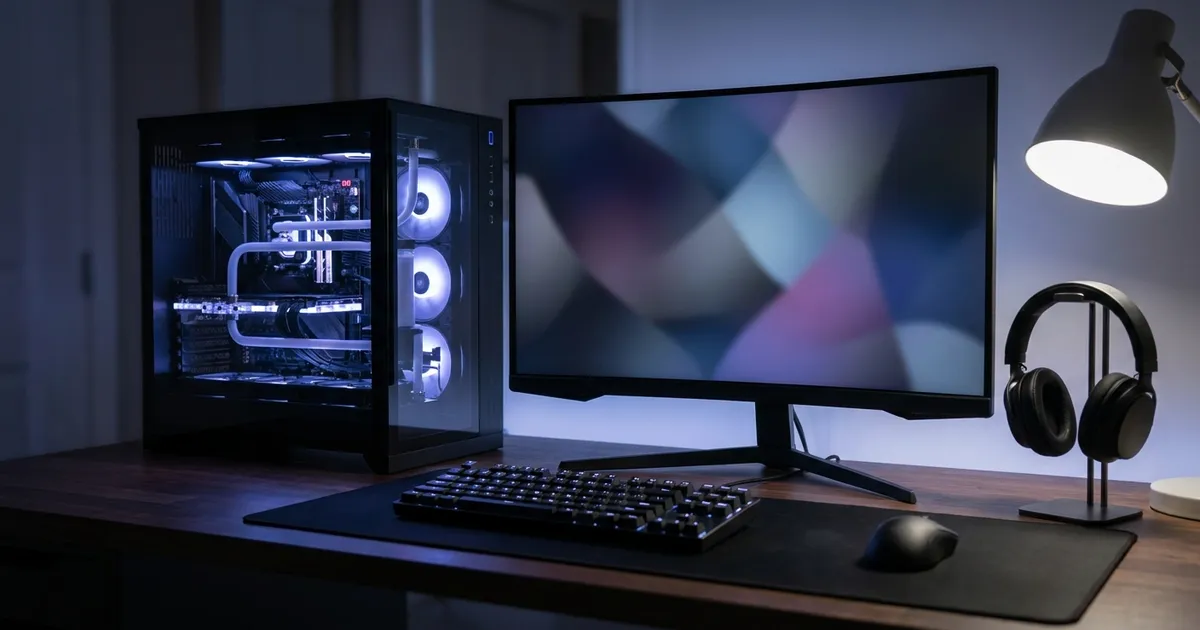
If you are searching for the best gaming PC setup to play GTA 6, here is the honest answer up front: nobody can give you a definitive spec sheet yet, because Rockstar has not announced a PC version and has not published a single official system requirement. GTA 6 launches November 19, 2026 on PS5 and Xbox Series X/S only. What follows is a practical, future-proofed build guide based on educated estimates, not a leak of real Rockstar specs, so you can have a capable machine ready whenever a PC release does happen.
Why bother building now with no official specs
Because the pattern is extremely consistent. GTA 5 launched on consoles in September 2013 and did not reach PC until April 2015, about eighteen months later. Red Dead Redemption 2 landed on consoles in October 2018 and arrived on PC in November 2019, roughly a year behind. Rockstar has shipped exactly zero PC versions alongside a console launch in the last two console generations. If GTA 6 follows either precedent, PC players are looking at something like twelve to eighteen months of waiting after the November 2026 console launch before there is anything to install. We cover the timing question in more depth in our GTA 6 PC release guide, so we will not re-litigate it here.
What that gap does give you is time. A PC bought or upgraded now will not sit idle waiting for one game. It plays everything else releasing between now and whenever GTA 6 shows up on Steam, and by the time Rockstar’s PC team finishes optimizing the port, a rig built around 2026’s demanding open-world benchmarks should hold up fine. Betting on a capable build ahead of a spec sheet is a reasonable move precisely because the wait is long enough for a good PC to earn its keep elsewhere first.
Table of contents
- Budget build
- Mid-range / 1440p build
- High-end / 4K build
- GPU considerations
- CPU considerations
- RAM considerations
- Storage considerations
- Power supply and cooling
- Monitor: 1440p high refresh vs 4K
- Upgrading an existing PC vs building new
- Peripherals worth having ready
- FAQ
Budget build
This tier targets 1080p at a locked 60fps with settings turned down where needed. It is aimed at someone who wants to play GTA 6 comfortably without official requirements to plan against, not someone chasing every visual setting.
| Component | Pick | Approx. price (2026) |
|---|---|---|
| GPU | RTX 4060 Ti (16GB) or RX 7700 XT | $380-430 |
| CPU | Ryzen 5 7600 or Intel Core i5-13400F | $200-230 |
| RAM | 16GB DDR5-5600 | $60-70 |
| Storage | 1TB NVMe Gen 4 SSD | $70-90 |
| PSU | 650W 80+ Bronze/Gold | $70-90 |
| Total | roughly $900-1,000 |
This is a serviceable floor, not a recommendation for anyone who cares about resolution or frame rate ceiling. Sixteen gigabytes of RAM and a 1TB drive are both going to feel tight within a year or two, especially once you factor in a game that could plausibly cross 150GB installed. Treat this tier as “gets you in the door,” not “built to last.”
Mid-range / 1440p build
This is the tier we would actually point most people toward. It is the sweet spot between price and the kind of headroom that keeps a build relevant for years, and it is where 1440p at 60fps or better becomes comfortable rather than a stretch.
| Component | Pick | Approx. price (2026) |
|---|---|---|
| GPU | RTX 4070 Ti Super (16GB) or RX 7900 XTX (24GB) | $750-900 |
| CPU | Ryzen 9 7900X3D or Intel Core i7-14700K | $400-450 |
| RAM | 32GB DDR5-6000 | $110-130 |
| Storage | 2TB NVMe Gen 4 SSD (7,000MB/s+ read) | $130-160 |
| PSU | 850W 80+ Gold | $110-140 |
| Cooling | 240mm AIO or high-end tower air cooler | $80-120 |
| Total | roughly $1,700-1,900 |
If you only read one section of this guide, make it this one. The jump from budget to mid-range buys you double the VRAM, double the RAM, double the storage, and a CPU that will not choke on the kind of NPC and traffic simulation open-world games lean on. Given that GTA 6 has no confirmed PC specs, this tier is the safest bet: enough headroom to absorb whatever the eventual port asks for without needing another CPU or GPU upgrade to enjoy it.
High-end / 4K build
For anyone chasing 4K resolution, maximum settings, or a high refresh rate at 4K, here is what that costs in 2026.
| Component | Pick | Approx. price (2026) |
|---|---|---|
| GPU | RTX 5080 (16GB GDDR7) or RTX 5090 (32GB GDDR7) | $1,100-2,000 |
| CPU | Intel Core i9-14900K/13900KF or Ryzen 9 9900X | $480-580 |
| RAM | 32GB DDR5-6400 (64GB if you also stream or edit) | $140-220 |
| Storage | 2TB+ NVMe Gen 5 SSD (7,000MB/s+ read) | $180-250 |
| PSU | 1000W 80+ Gold/Platinum | $150-200 |
| Cooling | 360mm AIO | $140-180 |
| Total | roughly $2,300-3,500+ |
The RTX 5090 pushes this well past $3,000 on its own merits, and it is overkill unless you are also doing 4K content creation or want the largest possible margin against a demanding port. The RTX 5080 is the more sensible high-end pick for most people: 16GB of GDDR7 is still a healthy buffer for open-world texture streaming, and it frees up several hundred dollars for a better monitor or more storage.
Value verdict: the mid-range 1440p build is where we would spend our own money. It is roughly half the cost of the high-end tier for a build that will run any realistic GTA 6 PC port at high settings without drama. The high-end tier is for people who have already decided they want 4K and are not looking to be talked out of it.
GPU considerations
Every number in this section is our own estimate based on how GTA 5 and RDR2 scaled on PC and how current 2026 open-world titles behave, not anything Rockstar has confirmed.
VRAM is the number to watch more than raw shader count. Open-world games stream textures continuously as you move through the map, and a game with a coastline, a dense city, swampland, and everything in between is going to have a lot of texture variety in memory at once. GTA 5’s PC version already leaned on VRAM more than console versions of the same era, and RDR2 followed the same trend. If GTA 6’s PC port scales the way those two did, 16GB should be treated as a comfortable minimum for 1440p and 4K, with 24GB as the safer margin if you want to run max settings without any texture streaming hitches. An 8GB card is not a good place to be for a game like this in 2026, even at 1080p.
At 1440p, an RTX 4070 Ti Super or RX 7900 XTX should give you 60fps and above with room to spare, based on how those cards handle current demanding open-world titles. At 4K, the RTX 5080 and 5090 are the realistic picks if you want high settings and a high frame rate rather than a compromise. AMD’s high-VRAM cards remain a legitimate alternative if you are shopping by price per gigabyte rather than brand loyalty.
CPU considerations
Quad-core CPUs are effectively dead for AAA open-world gaming at this point, and that will not change for GTA 6. Eight cores should be treated as the strong recommendation, not a nice-to-have. The reason comes down to what open-world games actually do with a CPU: traffic AI, pedestrian simulation, physics, and asset streaming all run in the background while the game renders, and GTA titles have always leaned harder on CPU than most shooters or linear games because of how much is simulated around you at any given moment.
Single-core performance still matters just as much as core count, because a lot of game logic runs on one or two dominant threads even when the engine spreads work across many cores. That is why the recommended tier pairs high core counts with strong per-core speed: Intel’s i9-14900K and i9-13900KF, or AMD’s Ryzen 9 7950X, 7900X3D, and 9900X. The X3D chips in particular tend to do well in game benchmarks because of their extra cache, which helps exactly the kind of large, streaming open world GTA 6 is expected to be.
If you are on a budget and have to choose between a stronger GPU and a stronger CPU, do not starve the CPU side entirely. A CPU bottleneck shows up as stutter and inconsistent frame times in a busy open world, which is a worse experience than a slightly lower average frame rate from a weaker GPU.
RAM considerations
Sixteen gigabytes is the absolute floor and honestly starting to feel thin even for current games, let alone whatever GTA 6 ends up needing on PC. Thirty-two gigabytes is the realistic sweet spot in 2026: it covers the game itself with room left for Discord, a browser with a dozen tabs, and recording or streaming software running in the background without forcing anything into a slow page file.
DDR5 at 6000MHz or faster is the standard for a new build this year. Speed matters somewhat, but capacity is the bigger lever for a game this size. If you are building fresh, spend the extra money on 32GB before you chase faster RAM timings.
Storage considerations
Sequential read speed above 7,000MB/s on your primary drive is the target for a new build, which puts you in PCIe Gen 4 NVMe territory at minimum, with Gen 5 drives now common in high-end builds. Faster storage means faster load times and less pop-in during fast travel or fast movement through a dense city, both of which open-world games are notoriously sensitive to.
Capacity is the part people underestimate. GTA 6 alone could plausibly exceed 150GB installed once textures, audio, and any bundled assets are accounted for, and a modern AAA library fills a drive fast when a handful of other games are each pushing 80 to 100GB. Two terabytes dedicated purely to gaming storage is a reasonable baseline for 2026, and if you already have a few live-service games installed alongside a rotating backlog, err toward more rather than less.
Power supply and cooling
Budget for at least 850W at 80+ Gold efficiency if you are running anything in the mid-range or high-end GPU tier. Current-generation high-end GPUs can spike past 400W under load, and a PSU with headroom runs cooler, lasts longer, and handles power spikes more gracefully than one sized right at the edge of what your components draw. Going 1000W for a top-tier build with an RTX 5090 is not overkill, it is just accurate sizing.
Cooling matters more than people expect once you are running a high core count CPU under sustained open-world load. Case airflow and a solid cooler keep clocks stable during long sessions rather than letting the CPU throttle after twenty minutes of continuous play. A 240mm AIO is a reasonable floor for the mid-range build, and a 360mm AIO is worth it for the high-end tier given how much heat a 14900K or a high-end Ryzen chip can produce under full load.
Monitor: 1440p high refresh vs 4K
This is a genuine tradeoff rather than a case where one answer is objectively correct.
A 1440p monitor running at 165Hz is a strong all-around choice: it is easier on the GPU than 4K, so you get higher and more consistent frame rates, and the resolution is still sharp enough that most people are not longing for more detail. If GTA 6 turns out to be as demanding as some of 2026’s other big open-world releases, 1440p high refresh gives you a much better shot at hitting that refresh rate consistently without spending high-end money on a GPU.
A 4K monitor at 144Hz or higher with a 1ms response time is the pick if visual detail matters more to you than raw frame rate, and you are willing to pay for the GPU that can drive it. Open-world games with dense environments and long draw distances tend to benefit visibly from 4K in a way that faster-paced competitive games do not, so if GTA 6 is the kind of game you want to slow down and look at, 4K is a defensible choice.
Neither option is wrong. If you are already leaning mid-range on the rest of your build, 1440p high refresh is the more balanced pairing. If you have committed to the high-end GPU tier, a 4K panel is what actually lets that card stretch its legs.
Panel type is worth a mention alongside resolution. A good IPS panel gives you accurate colors and wide viewing angles, which matters for a game built around a sunbaked, neon-lit coastal setting. VA panels tend to offer deeper blacks and better contrast, useful for the night driving scenes that Rockstar has leaned on heavily in both trailers so far. OLED monitors have come down in price through 2026 and are worth considering at either resolution if burn-in from static HUD elements does not worry you, since the contrast and response times are a clear step up over LCD technology.
Upgrading an existing PC vs building new
Not everyone needs to start from scratch. If you built a PC in the last three or four years, the smarter move is often a targeted upgrade rather than a full rebuild. Swapping just the GPU is the single most impactful change you can make for gaming performance, and it is usually the cheapest path to the estimated specs above if your CPU is already reasonably modern.
Check your CPU generation first. An eighth-generation Intel chip or a first-generation Ryzen part is old enough that it will bottleneck even a mid-range GPU in a CPU-heavy open-world game, so in that case a GPU-only upgrade will not get you the performance you are expecting. If your CPU is from the last three or four years and already sits at eight cores or more, a GPU and RAM upgrade alone can take an aging build most of the way to the mid-range tier described above without touching the motherboard.
RAM and storage upgrades are the cheapest wins available. If you are still running 16GB, bumping to 32GB is inexpensive and immediately useful across everything you play, not just a future GTA 6 port. The same goes for adding a second NVMe drive rather than replacing your primary one, since drive prices per gigabyte have come down enough that expanding capacity is rarely a hard decision.
One thing not worth doing is upgrading piecemeal against a spec sheet that does not exist yet. Buy for what current games need and what your budget comfortably allows, and treat any GTA 6 PC port as a bonus a capable machine will already be ready for, rather than the sole justification for the purchase.
Peripherals worth having ready
This is a secondary consideration next to the actual PC, but worth a quick mention. GTA has historically felt comfortable on a controller even on PC, largely because the driving and shooting were tuned around console pads for most of the series’ history. If you already have a controller you like from console gaming, it will very likely carry over fine. Keyboard and mouse still has the edge for precision aiming and faster menu navigation, and PC versions of past Rockstar games have supported both without forcing a choice, so there is no need to pick one right now. A wired or low-latency wireless controller alongside your usual keyboard and mouse covers both bases.
Wrapping up
Nothing above is a Rockstar spec sheet, because one does not exist yet. It is our best estimate based on how GTA 5 and RDR2 scaled on PC after their own console launches, current 2026 hardware benchmarks for demanding open-world games, and where the genre is generally heading. The mid-range 1440p build is the one we would put our own money into: enough GPU and CPU headroom to absorb whatever a real PC port asks for, without paying high-end prices for margin you may not need.
For the bigger picture on timing, read our GTA 6 PC release guide on when a PC version is actually likely to show up. If you want to know what you are even building toward, our GTA 6 map and Leonida breakdown covers the scale of the world this hardware will need to render, and our release date tracker has the latest on the November 19, 2026 console launch itself.
FAQ
Is GTA 6 coming to PC? Almost certainly, eventually. Rockstar has not announced a PC version or a date. Every past Rockstar open-world game has come to PC after a console-first launch, so a PC release is a reasonable expectation, just not a confirmed one.
What GPU do I need for GTA 6 on PC? Nobody knows for certain yet since there are no official requirements. Based on how GTA 5 and RDR2 scaled and current open-world benchmarks, an RTX 4070 Ti Super or RX 7900 XTX is a sensible floor for 1440p, with an RTX 5080 or 5090 for 4K.
How much storage should I set aside? Plan for at least 2TB dedicated to gaming storage. GTA 6 alone could plausibly exceed 150GB installed, and a modern game library fills a drive quickly alongside it.
Do I need 32GB of RAM or is 16GB enough? Sixteen gigabytes is a workable floor, but 32GB is the realistic sweet spot in 2026 once you account for background apps like Discord, a browser, and any recording software running alongside the game.
Is a quad-core CPU still okay for GTA 6? No. Eight cores should be treated as the strong minimum for AAA open-world gaming in 2026, since these games lean heavily on CPU for traffic, pedestrian, and streaming simulation.
Should I wait to build until GTA 6’s PC specs are announced? You could, but the wait after the console launch is likely to be a year or more based on past Rockstar releases. A capable mid-range or high-end PC built now will play everything else in the meantime and should hold up fine once real requirements appear.
This article is an independent estimate from SixHype, a fan site not affiliated with Rockstar Games. No official GTA 6 PC system requirements exist at the time of writing. Hardware pricing and recommendations reflect our read of the 2026 market and will be updated once Rockstar publishes real specs.