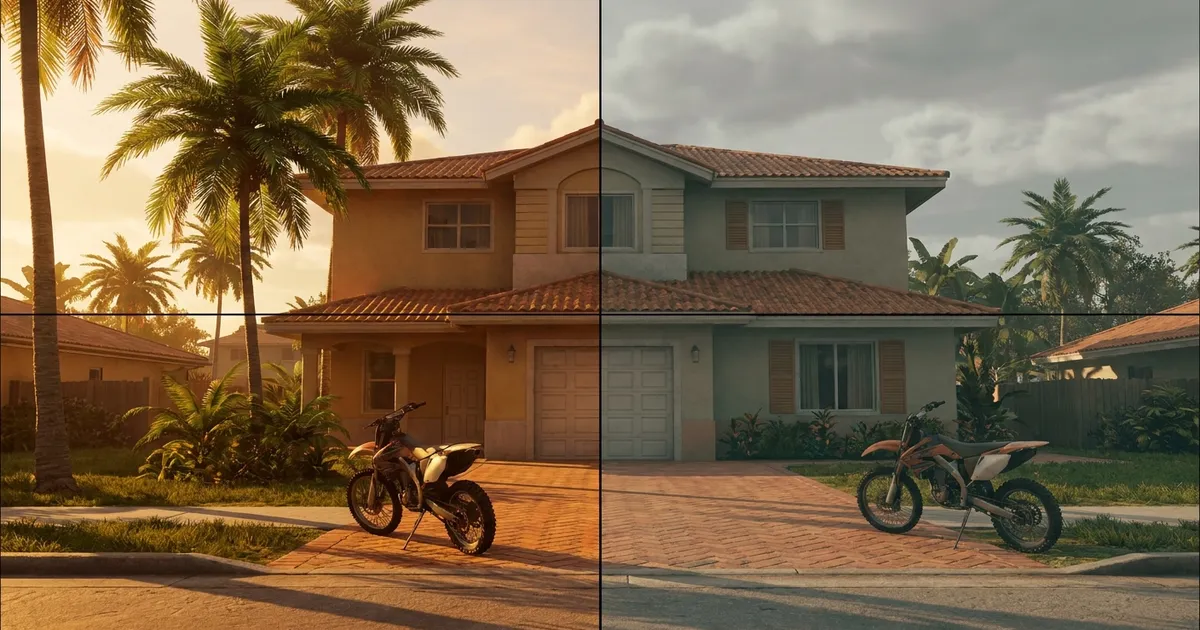
Rockstar released 63 official GTA 6 screenshots on June 24, 2026, and within hours a chunk of the fanbase decided the game had been downgraded. The short answer: there’s no real evidence of that. What actually happened is a lighting and camera mismatch between two different sources, one static screenshot and one cinematic trailer, that fans compared as if they were the same shot. Here’s exactly what got compared, what each side argued, what Digital Foundry found when it looked closer, and why this exact panic has happened before with almost every major open-world release.
Here’s what this guide covers:
- What actually happened on June 24
- The safehouse screenshot that started it
- Every specific “downgrade” claim, checked
- The counterargument: it’s lighting, not detail
- Digital Foundry’s twist: the screenshots might be too good
- This isn’t new: Rockstar’s history with downgrade panics
- When a downgrade claim turned out to be real
- How to actually check a downgrade claim yourself
- Why this keeps happening before every big release
- What we actually know about GTA 6’s final graphics
- FAQ
What actually happened on June 24
Rockstar published a batch of 63 official screenshots and artwork on June 24, 2026, a day ahead of GTA 6 preorders opening and the confirmation of the game’s $80 price point on June 25. The screenshots covered Jason and Lucia, several locations across Leonida, and street-level shots of Vice City. It was one of the biggest official image drops since the second trailer.
Within the same day, comparison threads started appearing on Reddit, X, and the GTA Forums, laying the new screenshots side by side with frames pulled from the second trailer. The claim spread fast: GTA 6 looked worse in the new screenshots than it did in the trailer, which meant Rockstar had quietly scaled back the game’s visuals. Kotaku covered the debate, as did TheGamer and Sportskeeda, all describing the same pattern: fans zooming into specific frames, treating minor visual differences as proof, and a separate, larger group of fans pushing back with an explanation that had nothing to do with reduced detail.
The safehouse screenshot that started it
The single image that drove most of the debate shows the exterior of Jason’s safehouse, with his dirt bike parked outside next to a patch of foliage. That exact location also appears in the second trailer, which made it an easy side-by-side comparison for anyone looking to build a case.
In the trailer, the scene is lit with warm, late-afternoon sunlight raking across the house. In the new screenshot, the same house sits under flatter, cooler light that reads as closer to midday or overcast conditions. Comparing the two, people zeroed in on the bushes next to the dirt bike, arguing they looked less detailed and less densely packed than the foliage in the trailer shot.
Every specific “downgrade” claim, checked
Once the safehouse comparison took off, fans extended the same argument to other parts of the screenshot batch. Here’s every specific claim that came up, and what it actually holds up to.
Foliage near Jason’s safehouse. The claim: the bushes look thinner and less detailed than the trailer. The reality: the two images use different lighting angles and, likely, different weather. Flat, diffuse light (like an overcast sky) reads as “less detailed” to the eye than warm directional light raking across the same leaves, even when the underlying geometry and texture data haven’t changed at all. This is a known effect in photography and 3D rendering alike, not a texture downgrade.
Jason’s hair and beard. The claim: Jason’s hair looks flatter and less textured in some screenshots than in close-up trailer shots. The reality: Rockstar, like every open-world developer, uses level-of-detail (LOD) scaling, where hair, cloth, and other expensive-to-render details get more rendering budget when a character is close to camera and less when they’re farther away or shot from a wider angle. A close-up cinematic shot from the trailer and a wider environmental screenshot are not directly comparable on hair detail for that reason alone.
Reflection quality. The claim: reflections in some screenshots look less sharp than trailer footage. The reality, per Digital Foundry’s own analysis (more on this below), points the opposite direction: several of the June 24 screenshots contain reflection detail that may actually exceed what PS5 and Xbox Series X can render in real time, not fall short of it.
General “flatness.” The broadest claim, and the hardest one to pin down, is that the screenshots simply look less impressive overall than the trailer. This is largely a byproduct of format: a screenshot is a single static frame with none of the camera movement, motion blur, or music that makes trailer footage feel more cinematic. Judging a static image against a moving, edited, sound-scored trailer sequence is not an apples-to-apples comparison of underlying graphical fidelity.
The counterargument: it’s lighting, not detail
The pushback case, which is the stronger one, rests on a simple point: comparing two images with different lighting, weather, and camera framing and calling the difference a “downgrade” isn’t a valid method, even when the comparison feels compelling at a glance.
Threads on r/GTA6 directly challenging the panic argue that people are treating zoomed-in crops of a single static screenshot the same way they’d treat a controlled benchmark of the same in-engine scene under identical conditions, and that framing has picked up real traction: it’s the same read Kotaku’s coverage of the debate landed on. In-game time-of-day and weather systems change how every surface in a scene reads, sometimes dramatically, without a single texture or polygon being altered. A rainy, overcast take of Jason’s safehouse and a golden-hour take of the same house are going to look different. That’s the engine doing its job, not evidence the engine got worse at its job.
There’s also a simpler tell worth pointing out: nobody claiming a downgrade compared like-for-like camera angles at like-for-like distances under like-for-like lighting. Every comparison driving the panic involves at least two of those three variables changing at once, which is exactly the condition under which two real, unmodified screenshots of the same location can look meaningfully different without any change in underlying quality.
Digital Foundry’s twist: the screenshots might be too good
The most interesting wrinkle in this whole debate doesn’t support the downgrade theory at all, it undercuts it. Digital Foundry, the technical analysis outlet most cited across GTA 6 coverage, looked at the June 24 screenshot batch and flagged the opposite problem: several images appear to contain ray-traced reflection detail beyond what PS5 or Xbox Series X can currently render in real time, which raises the possibility the screenshots were captured on PC hardware rather than console, or captured using development tools that don’t reflect any single platform’s final, shipped settings.
That distinction matters a lot for this debate. If the screenshots are, if anything, showing more graphical horsepower than the console hardware most players will actually use, the entire “downgrade” premise falls apart at the source. You can’t simultaneously argue a screenshot proves reduced detail and that the same screenshot may be rendering beyond console capability. Only one of those can be true, and the visual evidence lines up with the second one. Our PS5 and Xbox Series X performance guide goes deeper on why Digital Foundry believes GTA 6’s promotional material has consistently run ahead of what base consoles will show at launch, and why that gap is a frame-rate story, not a downgrade story.
This isn’t new: Rockstar’s history with downgrade panics
If this cycle feels familiar, that’s because it is. Downgrade panics are one of the most reliable pre-release rituals in gaming, and Rockstar has already lived through a version of it.
Red Dead Redemption 2 went through its own graphics-downgrade controversy in early 2019, months after launch. A patch appeared to reduce ambient occlusion quality on PS4 and Xbox One, and players circulated before-and-after screenshots as proof Rockstar had quietly scaled the game back, likely to smooth out performance on base consoles. Rockstar never confirmed the specific cause, and the debate over whether it was an intentional trade-off or a bug never fully settled. The core dynamic, fans building a visual case from screenshot comparisons without full information about what changed and why, is the same pattern playing out again with GTA 6, just before launch instead of after it.
The wider industry has an even more famous version of this story: Spider-Man’s 2018 “puddlegate” controversy, where fans compared a 2017 E3 demo against final gameplay footage and built an entire narrative around puddle reflections looking less detailed. It became one of the most-discussed “downgrade” cases in gaming history, and when the actual game shipped, the puddles, and everything else, looked and played fine. Nobody talks about puddlegate as a real downgrade anymore; they talk about it as an example of how easy it is to build a viral case out of a comparison that doesn’t hold up under scrutiny.
When a downgrade claim turned out to be real
It’s worth being fair to the downgrade side of this debate: real pre-release downgrades have happened before, so treating every claim as automatic hysteria isn’t right either. Ubisoft’s Watch Dogs is the textbook case. Its 2012 E3 demo, running on a high-end PC, showed richer lighting, denser crowds, and sharper detail than the game that actually shipped in 2014. Side-by-side comparisons of the E3 build against the retail build showed the same camera angle, the same location, the same time of day, and the same weather, and the final game still looked noticeably worse. Ubisoft’s own senior producer, Dominic Guay, later acknowledged PS4 and Xbox One hardware limitations played a role, and a PC modder eventually found leftover files from the original, higher-fidelity build still buried in the shipped game’s code.
That’s what a real, provable downgrade looks like: matched conditions, a confirmed hardware explanation, and physical evidence (the leftover asset files) backing up the visual comparison. The GTA 6 safehouse comparison has none of that. The two images being compared don’t share a camera angle, lighting condition, or even a confirmed capture platform, and no leaked files, developer statement, or independent technical teardown has surfaced supporting a reduction in detail. The Watch Dogs case shows the bar real evidence has to clear. The GTA 6 screenshots don’t clear it.
How to actually check a downgrade claim yourself
Next time a “downgrade” comparison starts circulating, whether it’s about GTA 6 or any other game, a few quick checks separate a real signal from a viral false alarm.
- Same location, same angle. If the two images aren’t framed from close to the same camera position, differences in what’s visible and how it’s lit are expected, not suspicious.
- Same time of day and weather. Open-world games with dynamic lighting can make one location look dramatically different depending on sun angle, cloud cover, or in-game weather state. This alone accounts for most viral “downgrade” comparisons.
- Same platform, ideally confirmed. A screenshot captured on a high-end PC and one captured on base console hardware are not the same data point, even if everything else lines up.
- Static image versus moving footage. A single screenshot will always look different from a color-graded, edited trailer sequence. That’s a format difference, not a fidelity difference.
- Is there a confirmed technical explanation, or just a visual vibe? The Watch Dogs downgrade held up because a developer eventually explained it and leftover files backed it up. A comparison that only exists as a side-by-side image with no supporting explanation is a claim, not evidence.
Run the June 24 GTA 6 comparisons through that checklist and they fail on at least three of the five points. That’s the difference between a real downgrade story and a viral misread.
Why this keeps happening before every big release
There’s a structural reason this cycle repeats itself with almost every major game, not just Rockstar’s. Promotional trailers are built to be the best possible version of a game: curated camera angles, ideal lighting, often captured on the most powerful hardware available, sometimes edited or color-graded afterward. Screenshots released later in a marketing cycle, especially ones meant to show off specific locations or characters for a media kit, are frequently captured under more ordinary, representative conditions, closer to what players will actually experience.
Put a highlight reel next to a representative sample, and the highlight reel almost always wins the comparison, not because the game got worse, but because the two pieces of material were never built to be compared against each other in the first place. Add in genuine excitement and anxiety in a fanbase that has waited over a decade for this specific game, and a handful of pixel-level differences are enough to spark a real debate, even when the underlying explanation is mundane.
None of that means downgrades never happen. They do, sometimes for good reasons like stabilizing frame rate across a wider range of hardware. But “downgrade” is a specific, falsifiable claim, and specific claims need specific, like-for-like evidence: same location, same time of day, same weather, same camera distance, same platform. The June 24 comparisons driving this panic don’t clear that bar, and the strongest technical read available right now, Digital Foundry’s, points toward the screenshots overshooting console hardware, not undershooting it.
What we actually know about GTA 6’s final graphics
Strip away the panic and here’s the actual state of confirmed information: Rockstar has not published final graphics settings, resolution targets, or frame rate numbers for GTA 6 on any platform. The June 24 screenshots are official Rockstar material, but their exact capture conditions, including which hardware and which graphics settings were used, have not been disclosed. No credible technical analyst, including Digital Foundry, has concluded the game’s actual visual fidelity has been reduced from what earlier trailers showed. If anything, the available analysis leans toward the screenshots representing a high, possibly PC-tier, visual ceiling rather than a downgraded floor.
Real, verifiable questions about GTA 6’s final graphics, like exactly how PS5 Performance Mode will compare to Quality Mode, remain open and worth tracking. Whether the game has been secretly downgraded from what fans saw in trailers is not currently one of them. This page will be updated if Rockstar, Digital Foundry, or another credible technical source publishes new information that changes that read.
FAQ
Is GTA 6 actually downgraded?
No credible evidence supports that. The screenshots fans point to as proof were shot under different lighting and weather conditions than the earlier trailer footage they were compared against, and Digital Foundry has argued the June screenshots may actually exceed what current-gen consoles can render, not fall short of it.
Why do people think GTA 6 was downgraded?
A batch of 63 official screenshots released on June 24, 2026 showed Jason’s safehouse in flatter, more overcast light than the same location in the second trailer. Fans zoomed in on the foliage, Jason’s hair, and reflections near the house and concluded detail had been reduced, without accounting for the lighting and camera differences between the two sources.
Did Rockstar respond to the graphics downgrade claims?
No. Rockstar has not issued any statement addressing the downgrade debate, and has not confirmed the exact hardware or settings used to capture the June 24 screenshots.
Were the June 24 GTA 6 screenshots even captured on PS5 or Xbox Series X?
That is unconfirmed and disputed. Digital Foundry, the technical analysis outlet that closely tracks Rockstar releases, has argued the screenshots contain ray-traced reflection detail beyond what current-gen consoles can render in real time, suggesting they may have been captured on PC hardware rather than PS5 or Xbox Series X.
Has this happened with other Rockstar games before?
Yes. Red Dead Redemption 2 went through its own graphics-downgrade debate after a 2019 patch appeared to reduce ambient occlusion quality, and pre-release “downgrade” panics are a recurring pattern across the industry, most famously with Spider-Man’s “puddlegate” controversy in 2018, which never showed up in the shipped game.
SixHype is an independent fan site with no affiliation to Rockstar Games or Take-Two Interactive. For the console frame-rate side of GTA 6’s technical debate, see our PS5 and Xbox Series X performance breakdown, and for everything else confirmed so far, check our release date hub.