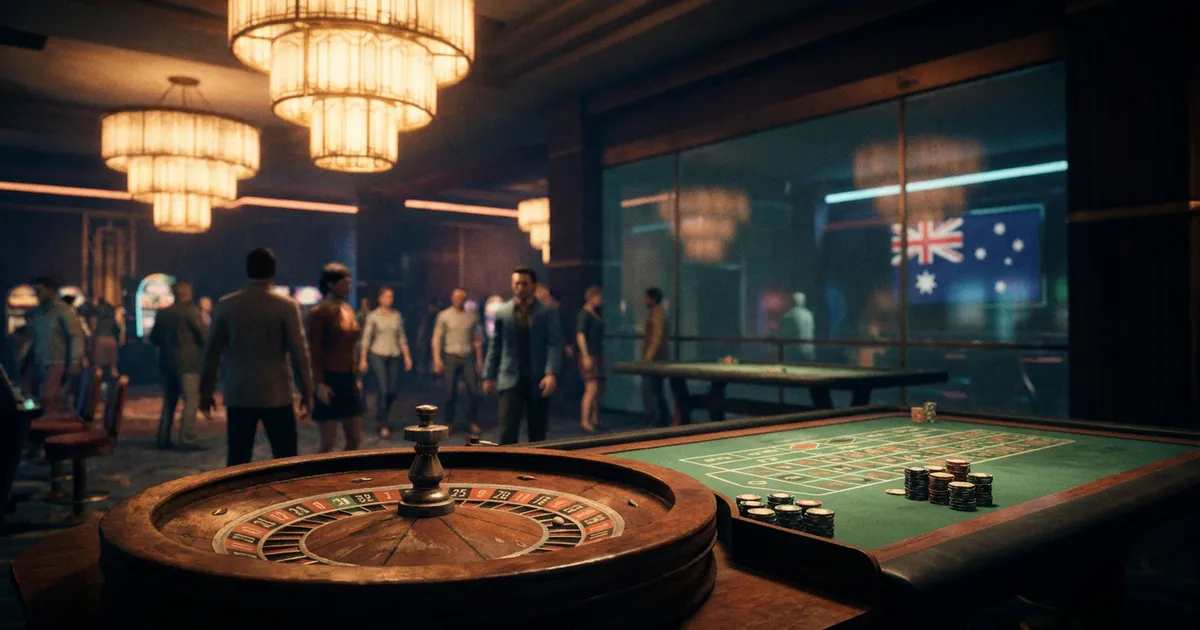
Rockstar didn’t announce it, didn’t patch-note it, and didn’t explain it. On July 28, 2026, GTA Online players in Australia logged in and found the Diamond Casino half switched off. Blackjack, roulette, slots, three-card poker, Inside Track, even the free daily Lucky Wheel spin, all of it started returning a message saying the feature isn’t available. Nobody outside Rockstar has confirmed why in an official statement, but the timing points squarely at Australia’s gambling and age-verification laws, and the whole episode is a live preview of the exact system GTA 6 will need to run on when it launches in dozens of countries with dozens of different rulebooks.
Here’s what actually happened, which law is really behind it, and what it tells us about how GTA 6 will handle money-making systems on day one.
What got blocked, exactly
The restriction is narrow. Australian GTA Online players can still walk into the Diamond Casino & Resort, run the story missions tied to it, and buy, sell, or hold chips. What they lost is the ability to wager those chips on anything driven by chance. PC Gamer and GameSpot both confirmed the same list of disabled features once the change surfaced: blackjack, roulette, three-card poker, slots, Inside Track horse racing, the Casino House, and the free daily Lucky Wheel spin all now return a version of “this feature is not available for you” for accounts in the AU region.
The discovery came from respected GTA dataminer Tez2, who found a new code flag reading something like Gambling_Restricted_Geographic tied specifically to the “AU” region, as Vice reported. That’s a targeted, server-side switch, not a content patch. Rockstar can flip it per country without touching anything else in the game for anyone outside that region.
It isn’t an isolated casino change either. Red Dead Online’s in-game poker got the same treatment for Australian accounts around the same time, which rules out a one-off Diamond Casino bug and points at a policy applied wherever a Rockstar game simulates a wager.
Australia also isn’t the first country on this list. Per Vice’s reporting, more than 50 territories already had GTA Online’s casino gambling switched off before this, including Poland, Argentina, Greece, South Africa, and China. Rockstar has been quietly managing this feature by region for years. What makes the Australian case worth writing about isn’t the block itself. It’s the specific law behind it, and what that law means for a game that hasn’t launched yet.
The law behind the block
Australia’s Age-Restricted Material Codes came into force on March 9, 2026, under the country’s Online Safety Act, enforced by the eSafety Commissioner. The codes require platforms and games classified R18+ by the Australian Classification Board to verify that users are adults before granting access to specific categories of content, and simulated gambling is one of the categories named explicitly. GTA BOOM’s coverage of the shutdown lays out the likely mechanism plainly: if a game studio can’t reliably prove the person on the other end of a session is an adult, the cheaper and lower-risk move is to pull the feature for the entire country rather than gamble on getting individual age checks right. The penalty for getting it wrong is steep. Non-compliance with the Age-Restricted Material Codes can trigger civil penalties of up to AU$49.5 million per breach, a figure enforced by the eSafety Commissioner’s office.
GTA Online was already named as an in-scope title before the casino block happened. Australia’s broader age-verification requirement for R18+ online games took effect in the same March 2026 window, and Rockstar had already built some age-verification steps into GTA Online to satisfy it, ahead of ever touching the casino. The July 28 gambling block is best read as the same compliance program reaching its next, more specific target: not “are you an adult,” but “are you an adult accessing a feature this specific code names as gambling.”
It’s worth being precise here, because it’s easy to collapse two separate Australian stories into one law. A second, distinct piece of legislation, the Interactive Gambling Amendment (Gambling Reform) Bill 2026, was introduced to Australia’s Parliament on July 2, 2026 and is still working through a Senate committee inquiry. That bill is about gambling advertising: it would cap televised gambling ads at three per hour between 6 a.m. and 8:30 p.m., ban gambling ads during live sports broadcasts, and strengthen the national self-exclusion register, with a proposed commencement of January 1, 2027 if it passes. It has nothing to do with whether a video game can show you a virtual slot machine, pending or not. The casino block traces to the Age-Restricted Material Codes and their March 2026 gambling-content provisions, not to the advertising bill. Two different laws, two different targets, same broad political direction: Australian regulators are actively narrowing what gambling-adjacent content reaches minors, on multiple fronts, in the same year.
Why this matters for a game that hasn’t launched
GTA 6 doesn’t have a casino yet, at least not one Rockstar has confirmed. Nothing in this story is a leak, a feature list, or a statement from Rockstar about GTA 6’s online economy. But the mechanism on display here, a silent, per-country, feature-level restriction baked directly into server code, is precisely the infrastructure GTA 6 Online will need from the moment it launches.
Start with why Rockstar cares this much about getting it right. Recurrent consumer spending, the revenue bucket covering virtual currency, in-game purchases, and add-on content, made up roughly 78% of Take-Two’s net revenue in fiscal 2026, or $5.2 billion of a $6.66 billion year, and GTA Online is the single largest driver inside that number. Our monetization deep-dive covers those Take-Two disclosures in full. A company that dependent on an always-online economy doesn’t treat regional compliance as an afterthought. It treats it as core infrastructure, and the Australian casino block is the clearest public example yet of that infrastructure actually working: a specific feature, in a specific country, disabled without breaking anything else, in response to a specific law.
Second, GTA 6 will almost certainly inherit the same classification GTA V already holds in Australia. GTA V is rated R18+ there, and there is no realistic version of GTA 6 clearing a lower bar than the game it replaces, given Rockstar’s history and the series’ content. If GTA 6 launches with anything resembling a casino, a loot mechanic tied to chance, or any system a regulator decides counts as simulated gambling, the Australian precedent says Rockstar now has a tested, low-friction way to comply: a geographic flag, flipped quietly, with no announcement and no public defense. No confrontation, no court fight, no delayed patch. Just a feature disappearing for one country while the rest of the world keeps playing.
Take-Two’s next chance to speak to any of this publicly comes fast: the company reports fiscal 2027 first-quarter results on August 7, 2026, and our earnings call preview covers what analysts expect on pre-orders and launch guidance. Regional compliance costs rarely get their own line item on a call like that, but they sit underneath every recurrent-revenue number Take-Two reports.
That also means GTA 6 Online inherits this exact tension on day one, in every region with its own version of Australia’s law. The European Union, the United Kingdom, and a growing list of countries have their own loot box and simulated-gambling scrutiny in various stages of legislation. Whatever monetization systems GTA 6 Online ships with, and Rockstar has confirmed nothing publicly, they will need to be built with per-region kill switches from the start, not retrofitted after a regulator complains. Australia just showed what that retrofit looks like when it’s done to an eight-year-old game already running live. Doing it to a brand-new game at launch is a different, harder problem, and it’s one GTA 6’s online systems will be tested on almost immediately.
What players are actually saying
Reaction split cleanly into two camps once the change went public. One side treated it as a straightforward loss of paid-for content, arguing along the lines that the casino was part of the product they originally bought and shouldn’t be pulled after the fact. The other side leaned into the obvious irony of a game built almost entirely around simulated crime drawing a hard line at simulated gambling specifically, with the general sentiment being that killing, drug trafficking, and grand theft are all fine ways to make money in GTA Online, but gambling is where a regulator steps in.
That second reaction is the funnier read, but it’s also the more accurate one. It isn’t that gambling is uniquely dangerous next to everything else the game lets you simulate. It’s that gambling is the one system tied to a named, actively enforced legal category, while carjacking a stranger isn’t classified content under any age-verification code. Regulators don’t weigh fictional severity. They enforce specific, defined categories, and simulated gambling happens to be one of the few GTA Online mechanics that maps cleanly onto an existing legal definition.
How this compares to GTA 6’s other Australia exposure
This isn’t Rockstar’s first brush with Australian regulation this year, and it won’t be the last before GTA 6 launches. The Age-Restricted Material Codes’ broader age-verification requirement, the part requiring ID checks or facial-age-estimation before accessing R18+ online content generally, applies to the entirety of GTA Online, not just the casino. Coverage from GTA BOOM has repeatedly noted that months after the law took effect, most Australian players still hadn’t encountered any actual age-check prompt when logging into GTA Online, suggesting Rockstar’s compliance rollout is happening in stages rather than all at once. The casino gambling block is the most concrete, verifiable piece of that rollout to surface publicly so far.
Rockstar’s own online mode has generated plenty of unverified claims about what systems it will and won’t include; our online rumor roundup ranks the credible ones against the noise, and none of them currently mention gambling-style mechanics specifically. For GTA 6, that staged pattern is the real lesson. Rockstar isn’t flipping every compliance switch simultaneously. It’s targeting the highest-risk, most legally explicit category first (simulated gambling, tied to a $49.5 million-per-breach penalty) and leaving broader, harder-to-enforce requirements like general age verification to roll out more slowly. Expect GTA 6 Online to follow the same order of operations: whatever system draws the most direct regulatory fire gets the fastest, quietest fix, and everything else follows on a longer timeline.
Australia and GTA have a longer history than one casino block
Australia hasn’t always had a legal category for content like this. Games in Australia had no adult rating at all until January 1, 2013, when the country’s R18+ classification for video games took effect for the first time, closing a long-running gap where any game the classification board deemed too extreme for MA15+ simply couldn’t be sold legally in the country. GTA V arrived seven months later, on July 31, 2013, and became one of the first major titles rated under the new R18+ tier, with the Australian Classification Board citing drug use as the primary reason for the rating. The game’s graphic torture sequence drew separate public criticism from advocacy groups at the time, though it was the drug-use content, not the torture scene, that the board formally cited in its consumer advice.
That history matters here because it shows Australia’s relationship with GTA has always run through specific, narrow classification triggers rather than a blanket judgment on the series. The board didn’t ban GTA V outright or demand a heavily cut version; it created a new ratings tier specifically so the game could be sold at all, then named the exact content category responsible. The 2026 casino block follows the identical pattern: not a ban on GTA Online, not a takedown, a narrow restriction on one legally defined category inside a much bigger game.
The wider loot box crackdown Rockstar is watching
Australia’s gambling code doesn’t exist in isolation, and Rockstar knows it. Belgium moved first and hit hardest: the Belgian Gaming Commission ruled in 2018 that paid loot boxes meeting the legal definition of a bet, chance, and a possible win counted as gambling under Belgian law, and the country now criminalizes non-compliant loot box mechanics with fines up to €800,000 and potential prison time for developers. EA, Blizzard, and Square Enix all pulled paid loot boxes from their games in Belgium rather than risk prosecution. The Netherlands took a messier path, briefly fining EA over FIFA’s loot boxes before a March 2022 court ruling narrowed what counts as a standalone gambling product under Dutch law, leaving paid loot boxes technically legal there for now while regulators keep pushing the European Commission for an EU-wide rule.
Set next to that backdrop, Australia’s move looks less like an outlier and more like one more country joining a slow-moving, uneven, but clearly directional global trend: chance-based monetization in games is getting harder to sell without some form of regional carve-out, and studios that want to keep operating everywhere need the technical ability to disable specific mechanics on a country-by-country basis. Rockstar just demonstrated it has exactly that capability, tested and working, on a live game with millions of concurrent players. Whatever GTA 6 Online eventually contains, it will launch into a regulatory map where Belgium bans, the Netherlands hesitates, Australia gates by age, and the list of countries with some kind of rule keeps growing every year GTA 6 spends in development.
FAQ
Is GTA Online’s casino gambling banned in Australia?
Yes. Since July 28, 2026, Australian GTA Online players can no longer wager on blackjack, roulette, three-card poker, slots, Inside Track, the Casino House, or the free daily Lucky Wheel spin. They can still enter the Diamond Casino, run its story missions, and buy or sell chips.
Why did Rockstar block GTA Online gambling in Australia?
Rockstar has not issued a statement, but the timing lines up with Australia’s Age-Restricted Material Codes, which took effect March 9, 2026, and explicitly name simulated gambling as content that needs to be kept away from anyone under 18 in R18+-rated games.
Does this affect GTA 6?
Not directly yet. GTA 6 has not launched and Rockstar has said nothing about its online mode’s features. But GTA 6 will almost certainly carry the same R18+ rating GTA V holds in Australia, so it will fall under the same law, and the casino block shows the exact enforcement method, a silent per-country code flag, that Rockstar now has ready to use.
Which other countries have GTA Online gambling restrictions?
More than 50 territories already had GTA Online’s simulated casino gambling switched off before Australia was added, including Poland, Argentina, Greece, South Africa, and China, according to Vice’s reporting on the Australian block.
Can Australian players still use the Diamond Casino at all?
Yes, partially. Story missions tied to the casino still work, and players can still buy, sell, and hold casino chips. Only the chance-based wagering features are blocked.
Is there a separate Australian gambling law affecting GTA?
Yes, but it’s a different one. The Interactive Gambling Amendment (Gambling Reform) Bill 2026 was introduced to Parliament on July 2, 2026 and is still under Senate committee review. It targets gambling advertising, not in-game features, and would cap TV gambling ads at three per hour with a proposed start date of January 1, 2027 if it passes. It is not the law behind the casino block.
The bottom line
Nothing about GTA 6’s own gambling systems is confirmed, because GTA 6 hasn’t launched and Rockstar has said nothing about what its online mode will contain. What is confirmed is that Rockstar already has a working, tested method for complying with strict regional gambling law without shutting down a game or drawing public attention to itself: a per-country code flag, flipped in response to a specific legal category, backed by real financial stakes on both sides. Australia’s Age-Restricted Material Codes forced that method into public view on July 28, 2026, and GTA 6 Online inherits the exact same playbook the moment it goes live in a world where Australia is far from the only country writing these rules. If GTA 6 ships with a casino or any chance-based system, watch for quiet, unannounced regional restrictions to follow the same pattern this one did, not a headline, just a feature that stops working in one place while the rest of the world keeps playing.
SixHype is an independent fan site and is not affiliated with Rockstar Games or Take-Two Interactive. All facts above are sourced to the outlets and public filings linked throughout; predictions about GTA 6’s own systems are explicitly labeled as such and reflect no confirmed information from Rockstar.
Sources: PC Gamer on the Australian gambling block, GameSpot on the disabled casino features, Vice on Tez2’s datamine and the 50+ prior-restricted territories, GTA BOOM on the likely compliance mechanism, GTA BOOM on Australia’s age-verification law rollout, PC Gamer on the Age-Restricted Material Codes taking effect, allthings.how on the AU$49.5 million penalty structure, Parliament of Australia on the Interactive Gambling Amendment (Gambling Reform) Bill 2026, Time on GTA V’s 2013 torture scene controversy, GTA Wiki on the Australian Classification Board’s R18+ history with the series, UC Press/Collabra on Belgium’s loot box gambling law enforcement, Promise Legal on 2026 loot box regulation across the EU, UK, and US.